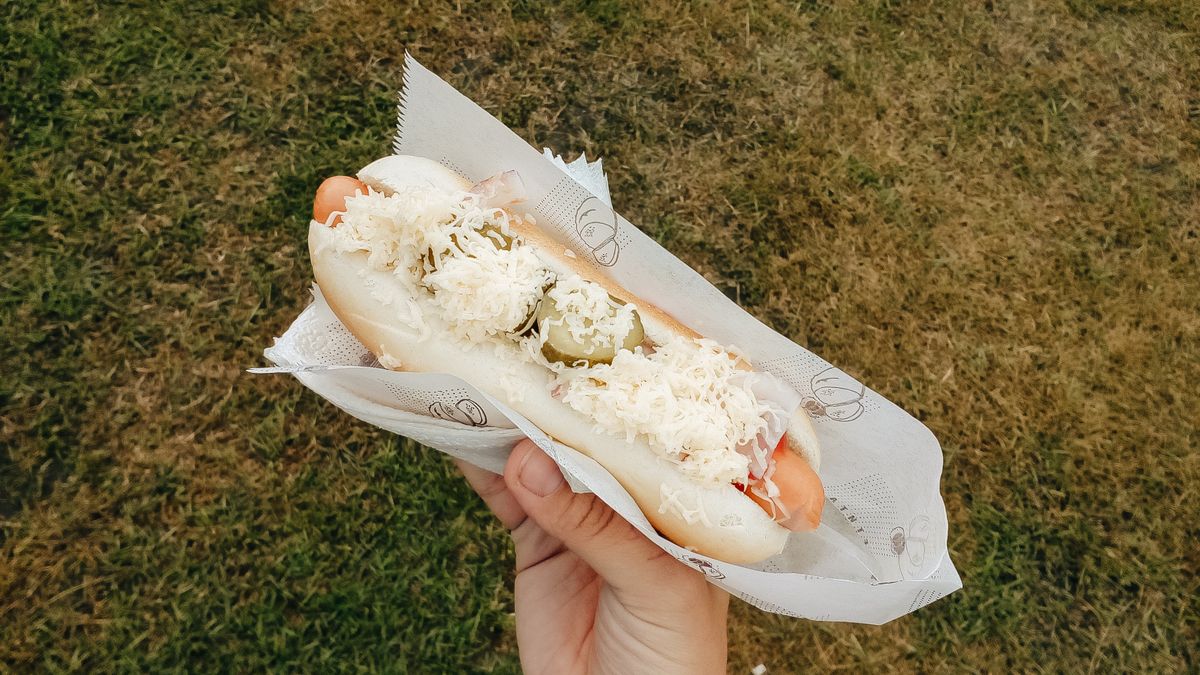
Every city has food rules. Chicago has food law, and no statute is enforced more zealously than the one governing the Chicago style hot dog: an all-beef frankfurter on a poppy seed bun, dressed with exactly seven toppings and absolutely no ketchup. It sounds fussy until you eat one done right, at which point it sounds like the only reasonable way to build a hot dog. Court is now in session.
The Seven-Topping Canon
Let us read the full liturgy, because every element earns its place. The foundation is an all-beef hot dog, traditionally with natural casing for the snap, steamed or simmered, laid into a steamed poppy seed bun. Then, in order: yellow mustard, chopped white onion, sweet pickle relish in that unmistakable neon green, sliced tomato, a kosher dill pickle spear, sport peppers, and a dusting of celery salt.
Notice the architecture. The mustard and onion handle sharpness. The relish brings sugar, the tomato brings freshness and acid, the pickle spear runs the length of the dog like a keel, the sport peppers deliver the heat, and the celery salt, the most underrated player on the roster, ties the whole thing together with a bitter herbal note you would miss the moment it was gone. This is not a pile of condiments. It is a balanced dish that happens to be handheld.
The neon relish deserves its own sentence: that impossible blue-green glow is a Chicago signature, and no, nothing in nature is that color, and no, nobody here cares. The poppy seed bun, popularized by the local bakeries that grew up alongside the hot dog trade, is equally non-negotiable. A plain bun works in an emergency. A Chicagoan will still notice.
Dragged Through the Garden
The full assembly has a name: a dog ordered with everything is "dragged through the garden," and the phrase tells you the origin story. The Chicago dog is Depression food, born in the 1930s when street vendors and stand owners, many of them Greek and Italian immigrants working alongside the city's Jewish sausage makers, sold a "Depression sandwich": a hot dog loaded with vegetables, a full meal's worth of produce on a nickel frankfurter.
The garden was the value proposition. Meat, bread, and seven toppings meant a working man's lunch that ate like a plate. The formula survived the Depression for the same reason the Italian beef did: engineered generosity tastes good in any economy.
The scale of the tradition still surprises visitors: hot dog stands remain genuinely everywhere in Chicago, from strip-mall counters to shacks that have outlived every building around them, and the city is often said to have more hot dog joints than the major burger chains combined. The dog is not a novelty here or a ballpark afterthought. It is neighborhood infrastructure, as ordinary and essential as a corner mailbox, which is exactly why the rules around it are taken so personally.
The canon then hardened the way canons do, through decades of repetition at hundreds of neighborhood stands, until deviation became visible, then suspicious, then unthinkable. There is no ordinance, no official registry. There does not need to be. Try ordering a Chicago dog with ketchup anywhere serious and watch civil society enforce itself.
Vienna Beef and the 1893 Origin Story
The dog itself has a birth certificate. Vienna Beef traces its history to the 1893 World's Columbian Exposition, where two Austro-Hungarian immigrants, Emil Reichel and Sam Ladany, sold their all-beef sausages to fairgoers and did well enough to open a shop. From that stand grew the company that still supplies a huge share of the city's hot dog stands, and whose logo on a sign functions as a quiet certification mark: real dog served here.
The all-beef part is not incidental. It comes out of Chicago's kosher-style sausage tradition, and it defines the flavor: beefy, garlicky, snappy, assertive enough to stand up to seven toppings. This is also why the Chicago dog resists imitation elsewhere; without the right frankfurter, the garden has nothing to grow on.
We find it fitting that the sandwich's origin is a world's fair. The Chicago dog has been showing off for out-of-towners since before your great-grandparents were born, and it has never once needed to update the act.
The Ketchup Taboo, Explained Seriously
Now the law's famous prohibition. No ketchup on a Chicago dog, ever, and here is the honest culinary reasoning: the dog already has sweetness from the relish, acid from the tomato and pickle, and sugar from the bun. Ketchup is sweetness plus acid in blunt concentrate. Add it and you double the sugar, flatten the balance, and bury the celery salt and sport peppers under a condiment engineered to dominate. The taboo is not superstition. It is recipe protection.
And, explained less seriously: the ban is also a shibboleth, a membership test, and one of the city's favorite running jokes. Some stands post signs about it. Gene & Jude's, of which more below, simply does not stock the stuff. Generations of Chicago parents have taught the rule to children with the gravity usually reserved for looking both ways before crossing.
The taboo has even earned official winks over the years: mustard-and-onion proclamations from public figures, menu signage that treats the red stuff like contraband, and the standing bit where a stand keeps one dusty bottle behind the counter purely for dramatic refusal. The joke works because everyone is in on it, including the tourists, eventually. No one is actually angry. Everyone is absolutely serious. Holding those two truths at once is the most Chicago thing about the whole ritual.
The customary exemption, extended with a wink: children under twelve may do as they wish, and visitors get one warning. After that, you are choosing to be talked about.
Seven toppings, one forbidden condiment, and a poppy seed bun: the Chicago dog is the only sandwich in America with a constitution, and the ratification debate ended before your grandparents were born.
The Institutions: Portillo's and Superdawg
Portillo's is the front door of Chicago hot dog culture, a chain that began as a suburban trailer in the 1960s and grew into the region's beloved mass-market standard-bearer. Purists quibble, tourists queue, and the dog itself is a faithful rendition of the canon, served fast, everywhere, in rooms full of nostalgia props. It is many Chicagoans' first dog and nobody's last.
Superdawg is the romance. A family-run drive-in on the Northwest Side operating since 1948, crowned by two giant costumed hot dog statues on the roof, with carhop service to your window and a signature dawg dressed in its own house style, green tomato and all. It is one of the last true drive-ins in America and the single most charming place to eat a hot dog in this city. Go once for the food and forever after for the feeling.
Both are institutions in the proper sense: they did not follow the culture, they built it. Check their sites for current hours, and bring cash-level patience on summer weekends, because late June brings out the whole city.
The Institutions: Gene & Jude's and The Wieners Circle
Gene & Jude's, just over the city line in River Grove, is the minimalist counterargument to the seven-topping canon, and Chicagoans hold both truths without strain. The order here is a Depression dog: mustard, relish, onion, sport peppers, and a fistful of fresh-cut fries piled directly on top, wrapped tight. No ketchup on the premises. No seats either. You eat standing at a counter or leaning on your car, and it is perfect, and the line moves like a pit stop.
The Wieners Circle in Lincoln Park is the theater district of hot dogs: a late-night char dog stand famous for its charred-not-steamed dogs and for the loud, profane, entirely voluntary insult comedy traded between the counter staff and the after-midnight crowd. The char dog is legitimately excellent, which is the part people forget to mention. Go late for the show, go early for a quiet and outstanding dog, and know which experience you are ordering.
Between the four institutions you have the whole map: the chain, the drive-in, the minimalist, and the cabaret. A completist can do all four in one ambitious day. We have. We recommend a walk in between.
How to Order Like a Local
The phrase that does everything: "one with everything." Said at any proper stand, it produces the full seven-topping canon without further interrogation. If you want the Gene & Jude's style, ask for a Depression dog where appropriate. Beyond that, a short etiquette course:
- Know your order before you reach the counter; these lines move fast and are proud of it.
- Do not ask for ketchup. If you must, ask for it "for the fries" and accept the look.
- A char dog means grilled; a red hot is simply the local term for the dog itself.
- Eat it fresh and standing up; a Chicago dog does not travel more than ten minutes gracefully.
Seasonal strategy, since it is late June: hot dog stands are summer creatures. The drive-in glows on warm nights, beach trips and ballgames create natural dog occasions, and the walk-up windows that feel merely practical in February become genuinely festive by the solstice. Build the dog into an outdoor day rather than treating it as a destination meal, order at the window, eat within sight of the stand, and you are doing it exactly as the city intended.
Pair it the traditional way, with fries and a soft drink, and resist improvement. People occasionally ask us how the dog fits into a bigger eating itinerary, and our answer is that it is the opening move: a dog at noon leaves room for tacos at midnight, and our tour of the best tacos in Chicago is the natural second chapter for anyone eating their way across the city's counters.
One Dog, Whole City
Here is what the Chicago dog really teaches. This is a city that takes food seriously at every price point, that will argue with equal passion about a five-dollar frankfurter and a dry-aged porterhouse. The same civic personality that codified seven toppings also built the temples of beef we cover in our guide to the best steakhouses, and it fights the eternal two-crust war we referee in our survey of the best pizza in Chicago. The dog is just the most affordable seat at that table.
It is also, we would note, the great equalizer. Traders and teachers, aldermen and art students, everyone stands in the same line and eats the same seven toppings, and no amount of money buys a better version than the one the stand hands everybody else. Few foods anywhere are this democratic and this codified at the same time.
So order one with everything, stand in the June sun, and take the first bite with appropriate respect: snap, garden, heat, celery salt. The other canonical hour is two in the morning, when the floors in our guide to Chicago clubs empty out and the char dog stands become the most honest rooms in the city. Somewhere behind you a local is nodding. You have just eaten the city's constitution, and it needed no ketchup at all.
FAQ: Chicago Hot Dogs
What exactly goes on a Chicago-style hot dog?
Seven toppings on an all-beef frankfurter in a poppy seed bun: yellow mustard, chopped white onion, neon-green sweet pickle relish, sliced tomato, a kosher dill pickle spear, sport peppers, and celery salt. Ordered as "one with everything," it is known as a dog dragged through the garden.
Why is ketchup banned on Chicago hot dogs?
Culinarily, the dog already carries sweetness and acid from the relish, tomato, and pickle; ketchup doubles the sugar and buries the balance. Culturally, the ban became a badge of local identity enforced by tradition and teasing rather than law. Children are customarily granted an exemption.
Where should a visitor eat their first Chicago dog?
Portillo's is the accessible classic, Superdawg is the historic drive-in with carhop charm, Gene & Jude's serves the minimalist Depression dog with fries on top, and The Wieners Circle adds late-night char dog theater. Any of the four is a proper initiation; check their sites for current hours.