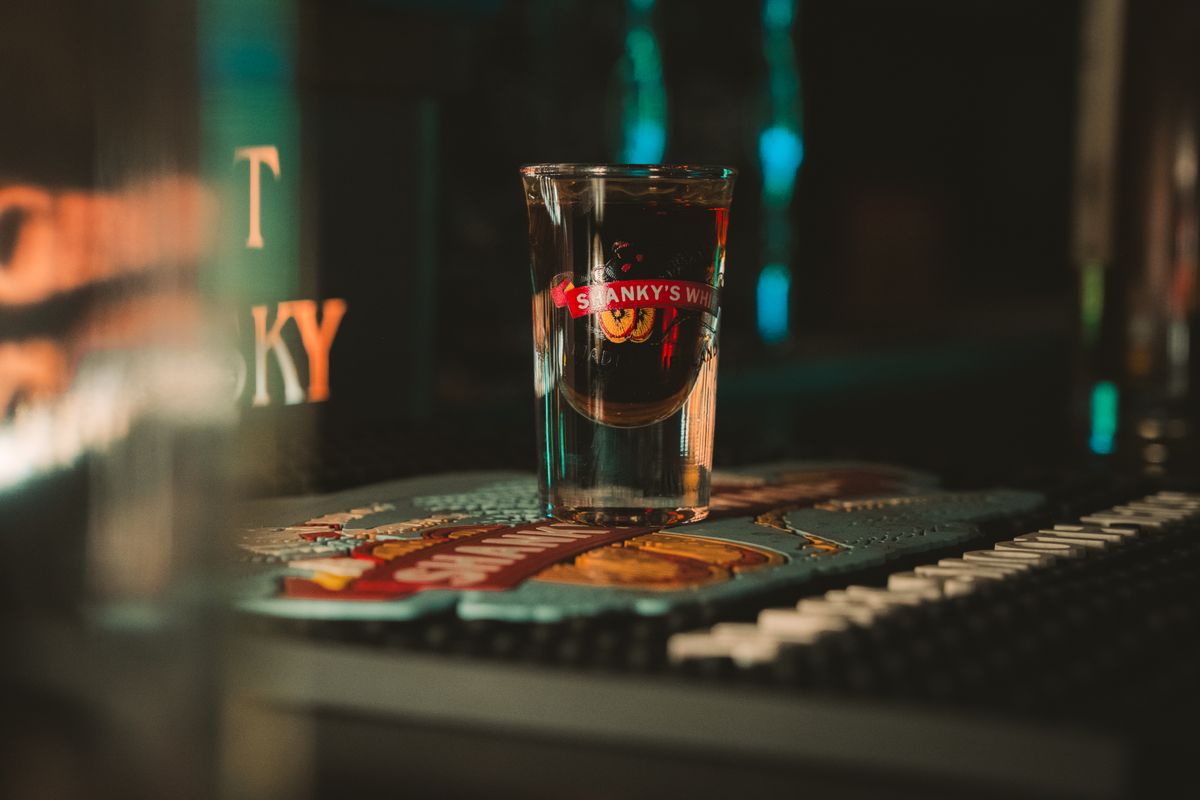
So, what is Malort? It is a wormwood-based liqueur, a Chicago rite of passage, and the only shot in America routinely ordered for someone the buyer claims to like. Officially it is Jeppson's Malort, a Swedish-style bitter spirit that has been distressing palates here for nearly a century. We have watched hundreds of first-timers take the plunge, and we are here to explain the history, the flavor, the famous grimace, and how to get through your own initiation with dignity mostly intact.
The Short Answer, Then the Long Grimace
Malort is a besk brannvin, which translates roughly from Swedish as "bitter distilled spirit." The word "malort" itself is Swedish for wormwood, the aggressively bitter botanical that gives absinthe its reputation and gives this liqueur nearly all of its personality. It pours a pale straw color, smells faintly of citrus and regret, and lands on the tongue with a bitterness that builds, plateaus, and then keeps building anyway.
Nobody drinks Malort because it is delicious. People drink it because it is Chicago's, in the same way the lakefront and a properly dragged-through-the-garden hot dog are Chicago's. It is a handshake, a hazing, a punchline, and lately, improbably, a point of genuine civic pride. Bartenders here keep a bottle within reach not for the flavor but for the moment: the second a tourist admits they have never tried it, the pour is already happening.
Carl Jeppson and the Swedish Roots
The story starts with Carl Jeppson, a Swedish immigrant who arrived in Chicago in the late 1800s and brought with him the old-country tradition of besk brannvin. In Sweden, wormwood spirits were folk medicine as much as refreshment, a bracing tonic taken for digestion, for colds, for whatever ailed you. Jeppson began peddling his version door to door and cigar shop to cigar shop, and the legend holds that his own palate was so wrecked by years of heavy smoking that Malort was one of the few things he could actually taste.
That detail may be polished by decades of retelling, but it captures something true about the product. Malort was never designed to be smooth. It was designed to be felt. The recipe that survives today is stubbornly simple: neutral spirit, wormwood, a touch of sweetness that arrives late and apologizes for nothing.
The Prohibition Loophole That Kept It Alive
Malort's great stroke of luck was the Volstead Act. When Prohibition shut down honest drinking in 1920, medicinal alcohol remained legal, and Jeppson leaned hard into the loophole. His pitch, according to the lore, was that Malort was a stomach tonic, not a beverage, and one taste was usually enough to convince a skeptical inspector that no human being would drink this thing for pleasure. The bitterness that should have doomed the product became its legal defense.
Whatever the precise truth of those stories, Malort survived the dry years when countless gentler spirits vanished, and it came out the other side with a small but devoted following on the city's Northwest Side, particularly among Scandinavian and Eastern European drinkers who recognized the style from home. For decades afterward it lived quietly in corner taverns, a bottom-shelf bottle with a top-shelf mythology slowly accruing around it.
Why It Tastes Like That
The culprit is wormwood, and specifically the compound absinthin, one of the most bitter substances known to food science. Human beings are wired to reject intense bitterness because in nature it often signals poison, so your first sip of Malort is essentially a negotiation between your brain stem and your civic pride. The flavor arrives in stages. First comes a deceptive moment of grapefruit pith and something almost floral. Then the bitterness rolls in, dry and botanical, and settles onto the back of your tongue like it pays rent there.
The finish is the famous part. Malort's aftertaste lingers for minutes, sometimes longer, a slowly fading hum of bitter that no chaser fully erases. Fans describe grapefruit, gasoline, burnt rubber, and pencil shavings, usually with affection. The distillery itself has historically embraced the abuse, marketing the stuff with slogans that read like dares. Few brands on earth have ever been this honest.
The Malort Face
Every first shot of Malort produces the same involuntary expression: eyes narrowing, lips pulling back, the whole face folding inward like a fist. Chicagoans call it the Malort face, and documenting it is half the fun. Long before social media, bartenders were angling mirrors so the whole rail could watch a newcomer's features collapse in real time. Now the ritual is fully photographed, a genre of portrait as local as the bean.
Malort is the only spirit we know that gets ordered for the reaction and drunk for the story.
The face is not optional and it is nothing to be ashamed of. We have seen veteran bartenders, spirits judges, and people who drink amaro for breakfast all make the face. Fighting it only makes it worse. The correct move is to let your features do what they need to do, exhale slowly, and accept the round of applause that usually follows.
The Chicago Handshake
Malort's natural habitat is not solo. It travels with a companion: a cold can or draft of Old Style, the beer whose logo has decorated Chicago tavern facades for generations. Together the shot and the beer form the Chicago Handshake, the city's unofficial welcome ceremony and the single most efficient way to signal that you understand where you are. The order is simple. Shoot the Malort, let the bitterness crest, then follow with a long pull of cheap, cold lager. The beer does not erase the wormwood so much as give it something to argue with.
You will find the Handshake offered at dive bars, at old-school taverns, and at the kind of burger-and-beer joints we cataloged in our roundup of the best burgers in Chicago, where a griddled smash patty turns out to be a shockingly good landing pad for a wormwood aftertaste. Some bars formalize the combo on the menu. Most just nod when you ask.
From Punchline to Renaissance
For most of the twentieth century, Malort was a regional oddity in slow decline, sustained by a handful of loyal taverns and the stubbornness of the Jeppson's brand's longtime steward, who famously kept the operation alive almost single-handedly for decades. Then something strange happened in the 2010s: irony curdled into affection. Bartenders started using Malort in actual cocktails. Comedians adopted it. Transplants began forcing it on visiting friends as a loyalty test. Sales climbed for the first time in generations.
The renaissance was cemented when CH Distillery, a craft operation based in the city, bought the brand and brought production back to Chicago after years of the liquid being distilled out of state, mostly in Florida of all places. A spirit named for wormwood, born on Clark Street, was finally being made at home again. The homecoming turned a punchline into a genuine local product story, and the city, which loves nothing more than an underdog with a bad attitude, embraced it completely.
The renaissance also changed how the stuff gets used. Serious bartenders now treat Malort the way Italians treat their harshest amari: as a seasoning, a modifier, a dare in liquid form. You will find it splashed into daiquiri variations, paired with grapefruit soda in tall summer drinks, stretched with honey and lemon, or floated on a shandy for people who want their beer to fight back. Purists grumble that mixing it misses the point, and they are not entirely wrong. But watching a talented bartender wrestle something balanced out of the most bitter bottle on the shelf is its own kind of Chicago entertainment, and a Malort cocktail remains the gentlest possible on-ramp for the wormwood-curious. Ask for one anywhere with a serious back bar. The bartender's grin will tell you that you have asked the right question.
How to Survive Your First Shot
There is no trick that makes Malort taste good. There are, however, tactics that make the experience survivable, and we offer them in the spirit of public service:
- Take it cold. A frozen bottle blunts the opening attack, though nothing blunts the finish.
- Do not sip. Sipping prolongs the negotiation. Commit, swallow, exhale.
- Have your chaser standing by. Old Style is traditional, but pickle brine and grapefruit soda both have their partisans.
- Do not eat anything delicate afterward. Whatever you taste next will taste like Malort.
- Let the face happen. Resistance reads as weakness and photographs worse.
The second shot, and there is often a second shot, is genuinely easier. Your palate recalibrates. Some people cross a threshold around the fifth or sixth lifetime shot where the bitterness starts to register as pleasantly bracing rather than punitive. These people are called regulars.
Where Malort Fits in a Night Out
Malort works best as punctuation. It opens a night with a jolt or seals a friendship at the end of one; it is rarely the whole evening's engine. Our favorite deployment is mid-crawl: you have had a beer somewhere, you are walking to the next stop, and someone proposes a quick Handshake at whichever tavern is nearest. It also thrives around live music, and plenty of the rooms in our guide to Chicago's essential live music venues keep a bottle behind the bar for between-sets courage. A shot of Malort before a blues set on Halsted is about as Chicago as an evening gets.
If you are building a fuller itinerary, the shot slots neatly into almost any route in our complete Chicago nightlife guide, from Loop after-work rooms to Logan Square's late stretch. Summer is prime season. Street festival crowds and back patios have a way of lowering inhibitions, and July in this city practically demands one ceremonial grimace per visitor.
The Gifting Culture
Malort may be the most gifted spirit in Illinois, and almost none of those bottles are gifts in the sincere sense. Chicagoans departing on trips pack airplane bottles to ambush unsuspecting friends in other cities. Transplants mail it home as edible postcards. Wedding welcome bags in this town have been known to include a mini bottle and a written apology. The joke is the gift, and the face is the thank-you note.
The tradition has rules, unwritten but firm. You do not warn the recipient beyond a vague "you have to try this." You do not film without at least the pretense of spontaneity. And you absolutely stay to watch, because abandoning someone mid-Malort-face violates the social contract that makes the whole exchange sporting rather than cruel. Veterans will tell you the gift eventually circles back: the person you initiated in 2019 shows up at your birthday with a full bottle and a camera ready.
There is real warmth underneath the prank. Handing someone Malort says: you are one of us now, or at least you are about to find out. The bottle has become civic shorthand, showing up on t-shirts, tattoos, and enamel pins. The ironic renaissance that saved this bottle was incubated in a specific set of neighborhood rooms, most of them clustered along the routes in our guide to Logan Square bars, where ordering one still counts as a personality trait. We recommend keeping one at home for exactly this purpose. Guests will ask about it. You know what happens next.
FAQ: Malort Basics
Does Malort actually contain wormwood, and is it safe?
Yes and yes. Wormwood is the defining botanical, and modern regulations limit the compound thujone to safe levels in any spirit sold in the United States. The only real danger Malort poses is to your dignity in the ten seconds after the shot goes down, and to whatever you planned on tasting for the rest of the hour.
What does the Chicago Handshake consist of?
A shot of Jeppson's Malort paired with an Old Style, typically a can or a draft. Take the shot first, then chase with the beer. Many taverns around the city will know exactly what you mean if you order it by name, and most will happily watch your face while you learn why.
Where is Malort made today?
After decades of being produced out of state, mostly in Florida, the brand was acquired by CH Distillery and production returned to Chicago. The recipe remains the traditional besk brannvin style: neutral spirit, wormwood, and a finish that outlasts most friendships. Check the distillery's site for current tour and tasting details.